Having viewed endless hours of YouTube videos on sailing monohulls and catamarans, we have often wondered how monohulls compare to catamarans. Now that we have spent time on both, we can answer that question for ourselves! Through our experiences, and a fair bit of research, we’ve come to appreciate the unique characteristics of each. There’s no single “better” option; it truly depends on what you’re looking for in a sailing experience. Here are some thoughts on the great debate:
Initial Impressions
Learning to operate the catamaran was a bit overwhelming. The size and complexity compared to the smaller monohulls we have sailed was a big difference. That said, after a little bit of time, we began to get a feel for how the two types of boats handle differently.
Sailing Experience
Ease of Sailing: Catamarans can be easier to handle in some ways. With all the lines running to the cockpit and simplified winches, we were able to manage the sails quite easily. However, it’s also true that learning to sail well is easier on a monohull (even more so on a small monohull) because you get better feedback from the boat and can feel the wind more directly. (Not to mention the pressure that comes with operating a massive, expensive vessel!! )
Upwind Sailing: Monohulls point higher (closer to head-on into the wind) than catamarans, and therefore, sail upwind better than catamarans, which can save you time if you’re having to tack.
Downwind Sailing: According to my research (we did not have an opportunity to do this in the BVI), catamarans excel at downwind sailing, particularly wing-on-wing sailing. (Wing-on-wing describes a way to sail directly downwind in a fore-and-aft rigged sailboat. The mainsail is extended out to one side of the boat, the foresail is extended out to the opposite side, creating a broad “wing” shape with the sails to catch the maximum amount of downwind force.) Monohulls can be a bit more challenging downwind and may require a whisker pole to keep the sails full.
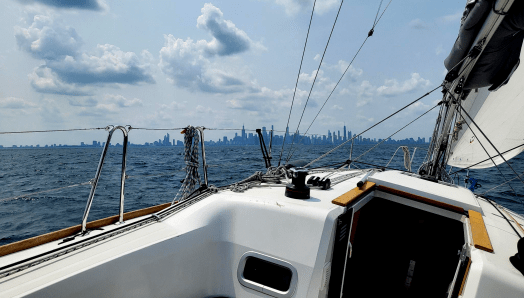
Heeling: This is where the biggest difference lies. Catamarans remain remarkably level even in rough conditions. This makes it easier to move around, manage sails, and even keep a drink from spilling. Monohulls, on the other hand, heel over considerably, which can be tiring and make even standing difficult. Constant heeling can wear you down over time. That being the case, though, I think this makes monohulls a little bit safer in rougher conditions because monohulls can self-adjust. In heavy wind or gusts, monohulls can heel and self-right, whereas catamarans may be at risk of capsizing.
Maneuvering
Docking: Much to our surprise, this is where catamarans shine. They are incredibly maneuverable in tight spaces. Using the two engines, a catamaran can be spun almost in its own length. On the other hand, monohulls can be challenging to dock due to less rudder effectiveness at slow speeds.
Shallow Water: While catamarans have a shallow draft, making them ideal for some anchorages, they also have two hulls, so if one hits the ground, there’s no tilting the boat to get it off. Monohulls, on the other hand, can heel over to get off of ground or lift their keel, making them more versatile in shallow areas.
Comfort and Livability
Comfort at Sea: I have to admit – our catamaran in the BVI was pretty darn comfortable. Catamarans are generally more comfortable at sea because they don’t heel. However, the motion can be quicker and more jerky than that of a monohull. Monohull motion is slower, but more dramatic, which can be tiring on long passages.
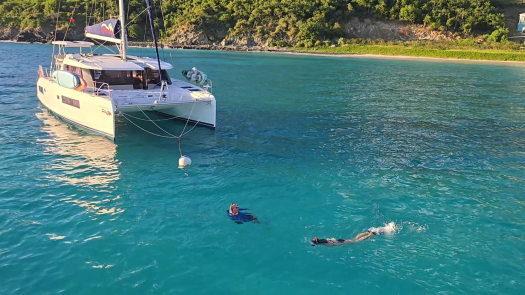
Comfort at Anchor: A catamaran is like a houseboat at anchor, with no rolling. This is a clear advantage over a monohull, which can be quite rolly. Some monohull sailors use “flopper stoppers” or a back anchor to stabilize the boat.
Space: Catamarans offer significantly more deck and living space. They have a large cockpit, trampolines, and often have easy water access with “sugar scoops”. Monohulls are smaller and may feel cramped in comparison.
Ventilation: Catamarans typically have many more opening ports than monohulls which contributes to better ventilation.
Organization: Catamarans provide a lot of storage space, which can make it easier to organize belongings.
Practical Considerations
Cost: Monohulls are significantly more affordable to purchase. Catamarans cost much more upfront. Also, berthing costs for catamarans are much higher, often 1.5 to 2 times the cost of a monohull.
Maintenance: Monohulls are less expensive to maintain. Catamarans have two engines, two rudders, and rigging that needs to be replaced more often. Hauling out a catamaran is also more expensive because you need to use a larger boatyard.
Tankage: Monohulls usually have significantly larger water and fuel tanks than catamarans.
Safety: It’s easier to fall off a monohull than a catamaran. However, it’s also important to consider that monohulls are at less risk of capsizing in windy conditions.
Our Dream Boat Revealed
Ultimately, the right boat really depends on your priorities. If you value stability, space, and comfort, and if your budget allows for it, a catamaran is hard to beat. We absolutely loved our sailing experience in the BVI on a catamaran and plan to enjoy more adventures like that in the future. However, for our retirement dreams, we are still set on a monohull. There’s just something about the traditional feel and connection to the water that resonates with us.
Discover more from SAIL & SAVOR BLOG
Subscribe to get the latest posts sent to your email.
 SAIL & SAVOR BLOG