In preparing for our first crossing of Lake Michigan (full discussion in an upcoming article!), I spent literally hours over printed charts, mapping our proposed route. Not going to lie—I loved it. Every minute of it. I’ve always been a map nerd; moving to nautical charts is like taking my old road atlas obsession and dialing it to 11.
Our plan was literally the least complex route imaginable: leave harbor, sail straight east for 36nm. And remember, the boat has $10k of electronics onboard to make sure we know to a thousandth of a degree where we are at any given moment. Enter one waypoint in the chartplotter and it will tell us to the second how long left in our trip. But I was savoring the old-fashioned way.
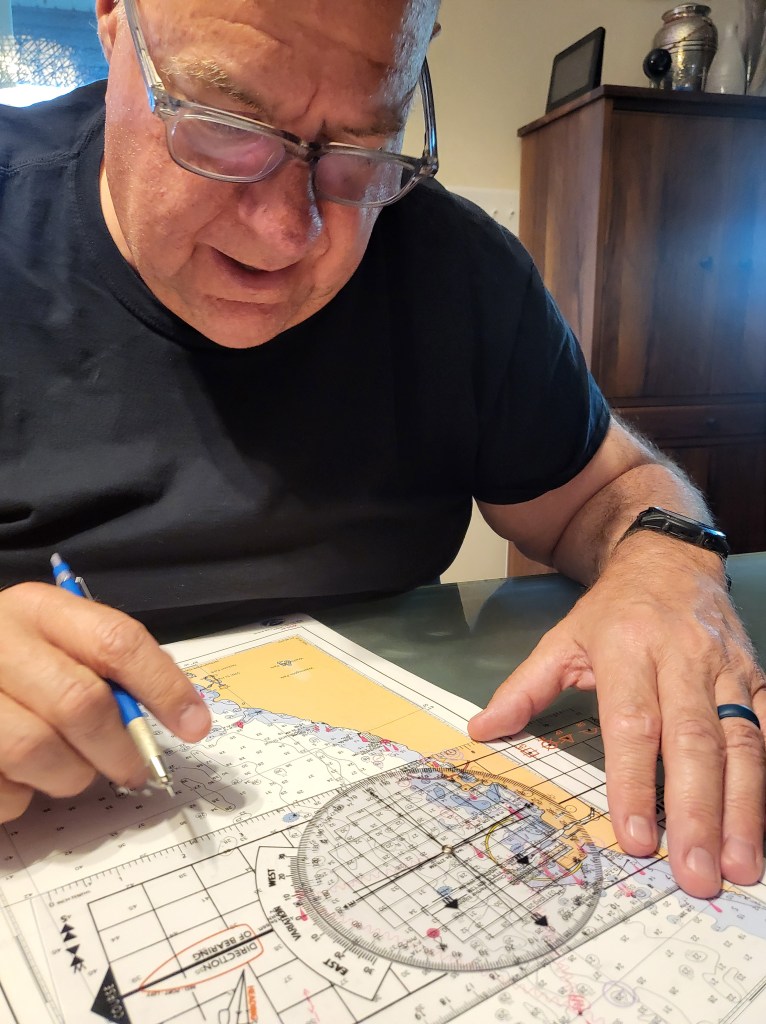
I drew a pencil line on the map where we wanted to go. Using a trick from a book we just listened to (Finding Your Way Without Map or Compass by Harold Gatty), I set us to intercept the shoreline a couple miles west of our destination so we knew for sure to head east when we got close. Carefully using a map protractor; a set of parallel rules; and the chart’s compass rose, I realized that from the mouth of Burnham Harbor we need to head 95.5 degrees, just very slightly south of due east. But I also knew from the chart that the difference between magnetic north and “true” north in our area was 4.5 degrees. So we were to steer precisely 100 degrees on the boat’s compass. I also checked the weather forecast obsessively, trying to gauge what the wind speed and direction would be. It changed a bit each day, but I thought we would be fine.
All of my planning hit a brick wall when we finally got on the water—and while the day was lovely and the water calm as glass—there was very little wind and what wind there was seemed to come directly from the direction of our destination. In the blink of an eye the most critical parts of my planning fell apart. Instead of 6 knots, we were struggling to get over 3. What’s more, to make headway against the wind we needed to tack back and forth. A little math showed that our actual distance sailed was going to double. With speed a half and distance double what we planned, it soon became clear that it was going to take us something like 24 hours to get there. Not going to work.
We fixed the situation with the “iron sail” (the boat’s diesel engine). All fine except a little bit noisy; the water was still smooth and we had a lovely time. But it was a good lesson in how the “best laid plans” could change in an instant, and a reminder that one of the things I like most about sailing is the way it keeps you humble. In a world where we get to pick our own news and curate every experience in our lives—sailing never lets you forget that nature operates without regard to our plans.
~Kent
Discover more from SAIL & SAVOR BLOG
Subscribe to get the latest posts sent to your email.
 SAIL & SAVOR BLOG